Lesson 2
Gulliver’s Travels recounts the story of Lemuel Gulliver, a practical-minded Englishman trained as a surgeon who takes to the seas when his business fails. In a deadpan first-person narrative that rarely shows any signs of self-reflection or deep emotional response, Gulliver narrates the adventures that befall him on these travels.
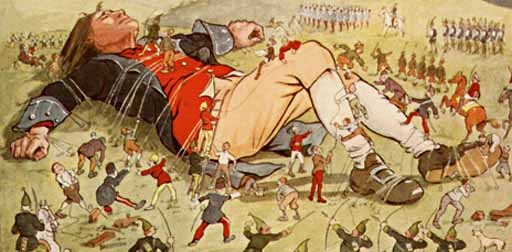
Gulliver’s adventure in Lilliput begins when he wakes after his shipwreck to find himself bound by innumerable tiny threads and addressed by tiny captors who are in awe of him but fiercely protective of their kingdom. They are not afraid to use violence against Gulliver, though their arrows are little more than pinpricks. But overall, they are hospitable, risking famine in their land by feeding Gulliver, who consumes more food than a thousand Lilliputians combined could. Gulliver is taken into the capital city by a vast wagon the Lilliputians have specially built. He is presented to the emperor, who is entertained by Gulliver, just as Gulliver is flattered by the attention of royalty. Eventually Gulliver becomes a national resource, used by the army in its war against the people of Blefuscu, whom the Lilliputians hate for doctrinal differences concerning the proper way to crack eggs. But things change when Gulliver is convicted of treason for putting out a fire in the royal palace with his urine and is condemned to be shot in the eyes and starved to death. Gulliver escapes to Blefuscu, where he is able to repair a boat he finds and set sail for England.
After staying in England with his wife and family for two months, Gulliver undertakes his next sea voyage, which takes him to a land of giants called Brobdingnag. Here, a field worker discovers him. The farmer initially treats him as little more than an animal, keeping him for amusement. The farmer eventually sells Gulliver to the queen, who makes him a courtly diversion and is entertained by his musical talents. Social life is easy for Gulliver after his discovery by the court, but not particularly enjoyable. Gulliver is often repulsed by the physicality of the Brobdingnagians, whose ordinary flaws are many times magnified by their huge size. Thus, when a couple of courtly ladies let him play on their naked bodies, he is not attracted to them but rather disgusted by their enormous skin pores and the sound of their torrential urination. He is generally startled by the ignorance of the people here—even the king knows nothing about politics. More unsettling findings in Brobdingnag come in the form of various animals of the realm that endanger his life. Even Brobdingnagian insects leave slimy trails on his food that make eating difficult. On a trip to the frontier, accompanying the royal couple, Gulliver leaves Brobdingnag when his cage is plucked up by an eagle and dropped into the sea.
Next, Gulliver sets sail again and, after an attack by pirates, ends up in Laputa, where a floating island inhabited by theoreticians and academics oppresses the land below, called Balnibarbi. The scientific research undertaken in Laputa and in Balnibarbi seems totally inane and impractical, and its residents too appear wholly out of touch with reality. Taking a short side trip to Glubbdubdrib, Gulliver is able to witness the conjuring up of figures from history, such as Julius Caesar and other military leaders, whom he finds much less impressive than in books. After visiting the Luggnaggians and the Struldbrugs, the latter of which are senile immortals who prove that age does not bring wisdom, he is able to sail to Japan and from there back to England.
Finally, on his fourth journey, Gulliver sets out as captain of a ship, but after the mutiny of his crew and a long confinement in his cabin, he arrives in an unknown land. This land is populated by Houyhnhnms, rational-thinking horses who rule, and by Yahoos, brutish humanlike creatures who serve the Houyhnhnms. Gulliver sets about learning their language, and when he can speak he narrates his voyages to them and explains the constitution of England. He is treated with great courtesy and kindness by the horses and is enlightened by his many conversations with them and by his exposure to their noble culture. He wants to stay with the Houyhnhnms, but his bared body reveals to the horses that he is very much like a Yahoo, and he is banished. Gulliver is grief-stricken but agrees to leave. He fashions a canoe and makes his way to a nearby island, where he is picked up by a Portuguese ship captain who treats him well, though Gulliver cannot help now seeing the captain—and all humans—as shamefully Yahoolike. Gulliver then concludes his narrative with a claim that the lands he has visited belong by rights to England, as her colonies, even though he questions the whole idea of colonialism.
2. Character List 
Might Versus Right
Gulliver’s Travels implicitly poses the question of whether physical power or moral righteousness should be the governing factor in social life. Gulliver experiences the advantages of physical might both as one who has it, as a giant in Lilliput where he can defeat the Blefuscudian navy by virtue of his immense size, and as one who does not have it, as a miniature visitor to Brobdingnag where he is harassed by the hugeness of everything from insects to household pets. His first encounter with another society is one of entrapment, when he is physically tied down by the Lilliputians; later, in Brobdingnag, he is enslaved by a farmer. He also observes physical force used against others, as with the Houyhnhnms’ chaining up of the Yahoos. But alongside the use of physical force, there are also many claims to power based on moral correctness. The whole point of the egg controversy that has set Lilliput against Blefuscu is not merely a cultural difference but, instead, a religious and moral issue related to the proper interpretation of a passage in their holy book. This difference of opinion seems to justify, in their eyes at least, the warfare it has sparked. Similarly, the use of physical force against the Yahoos is justified for the Houyhnhnms by their sense of moral superiority: they are cleaner, better behaved, and more rational. But overall, the novel tends to show that claims to rule on the basis of moral righteousness are often just as arbitrary as, and sometimes simply disguises for, simple physical subjugation. The Laputans keep the lower land of Balnibarbi in check through force because they believe themselves to be more rational, even though we might see them as absurd and unpleasant. Similarly, the ruling elite of Balnibarbi believes itself to be in the right in driving Lord Munodi from power, although we perceive that Munodi is the rational party. Claims to moral superiority are, in the end, as hard to justify as the random use of physical force to dominate others.
The Individual Versus Society 
Like many narratives about voyages to nonexistent lands, Gulliver’s Travelsexplores the idea of utopia—an imaginary model of the ideal community. The idea of a utopia is an ancient one, going back at least as far as the description in Plato’s Republic of a city-state governed by the wise and expressed most famously in English by Thomas More’s Utopia. Swift nods to both works in his own narrative, though his attitude toward utopia is much more skeptical, and one of the main aspects he points out about famous historical utopias is the tendency to privilege the collective group over the individual. The children of Plato’s Republicare raised communally, with no knowledge of their biological parents, in the understanding that this system enhances social fairness. Swift has the Lilliputians similarly raise their offspring collectively, but its results are not exactly utopian, since Lilliput is torn by conspiracies, jealousies, and backstabbing.
The Houyhnhnms also practice strict family planning, dictating that the parents of two females should exchange a child with a family of two males, so that the male-to-female ratio is perfectly maintained. Indeed, they come closer to the utopian ideal than the Lilliputians in their wisdom and rational simplicity. But there is something unsettling about the Houyhnhnms’ indistinct personalities and about how they are the only social group that Gulliver encounters who do not have proper names. Despite minor physical differences, they are all so good and rational that they are more or less interchangeable, without individual identities. In their absolute fusion with their society and lack of individuality, they are in a sense the exact opposite of Gulliver, who has hardly any sense of belonging to his native society and exists only as an individual eternally wandering the seas. Gulliver’s intense grief when forced to leave the Houyhnhnms may have something to do with his longing for union with a community in which he can lose his human identity. In any case, such a union is impossible for him, since he is not a horse, and all the other societies he visits make him feel alienated as well.
Gulliver’s Travels could in fact be described as one of the first novels of modern alienation, focusing on an individual’s repeated failures to integrate into societies to which he does not belong. England itself is not much of a homeland for Gulliver, and, with his surgeon’s business unprofitable and his father’s estate insufficient to support him, he may be right to feel alienated from it. He never speaks fondly or nostalgically about England, and every time he returns home, he is quick to leave again. Gulliver never complains explicitly about feeling lonely, but the embittered and antisocial misanthrope we see at the end of the novel is clearly a profoundly isolated individual. Thus, if Swift’s satire mocks the excesses of communal life, it may also mock the excesses of individualism in its portrait of a miserable and lonely Gulliver talking to his horses at home in England.
The Limits of Human Understanding
The idea that humans are not meant to know everything and that all understanding has a natural limit is important in Gulliver’s Travels. Swift singles out theoretical knowledge in particular for attack: his portrait of the disagreeable and self-centered Laputans, who show blatant contempt for those who are not sunk in private theorizing, is a clear satire against those who pride themselves on knowledge above all else. Practical knowledge is also satirized when it does not produce results, as in the academy of Balnibarbi, where the experiments for extracting sunbeams from cucumbers amount to nothing. Swift insists that there is a realm of understanding into which humans are simply not supposed to venture. Thus his depictions of rational societies, like Brobdingnag and Houyhnhnmland, emphasize not these people’s knowledge or understanding of abstract ideas but their ability to live their lives in a wise and steady way. The Brobdingnagian kingknows shockingly little about the abstractions of political science, yet his country seems prosperous and well governed. Similarly, the Houyhnhnms know little about arcanesubjects like astronomy, though they know how long a month is by observing the moon, since that knowledge has a practical effect on their well-being. Aspiring to higher fields of knowledge would be meaningless to them and would interfere with their happiness. In such contexts, it appears that living a happy and well-ordered life seems to be the very thing for which Swift thinks knowledge is useful.
Swift also emphasizes the importance of self-understanding. Gulliver is initially remarkably lacking in self-reflection and self-awareness. He makes no mention of his emotions, passions, dreams, or aspirations, and he shows no interest in describing his own psychology to us. Accordingly, he may strike us as frustratingly hollow or empty, though it is likely that his personal emptiness is part of the overall meaning of the novel. By the end, he has come close to a kind of twisted self-knowledge in his deranged belief that he is a Yahoo. His revulsion with the human condition, shown in his shabby treatment of the generous Don Pedro, extends to himself as well, so that he ends the novel in a thinly disguised state of self-hatred. Swift may thus be saying that self-knowledge has its necessary limits just as theoretical knowledge does, and that if we look too closely at ourselves we might not be able to carry on living happily.
Motifs:
Excrement
While it may seem a trivial or laughable motif, the recurrent mention of excrement in Gulliver’s Travels actually has a serious philosophical significance in the narrative. It symbolizes everything that is crass and ignoble about the human body and about human existence in general, and it obstructs any attempt to view humans as wholly spiritual or mentally transcendent creatures. Since the Enlightenment culture of eighteenth-century England tended to view humans optimistically as noble souls rather than vulgar bodies, Swift’s emphasis on the common filth of life is a slap in the face of the philosophers of his day. Thus, when Gulliver urinates to put out a fire in Lilliput, or when Brobdingnagian flies defecate on his meals, or when the scientist in Lagado works to transform excrement back into food, we are reminded how very little human reason has to do with everyday existence. Swift suggests that the human condition in general is dirtier and lowlier than we might like to believe it is.
Foreign Languages
Gulliver appears to be a gifted linguist, knowing at least the basics of several European languages and even a fair amount of ancient Greek. This knowledge serves him well, as he is able to disguise himself as a Dutchman in order to facilitate his entry into Japan, which at the time only admitted the Dutch. But even more important, his linguistic gifts allow him to learn the languages of the exotic lands he visits with a dazzling speed and, thus, gain access to their culture quickly. He learns the languages of the Lilliputians, the Brobdingnagians, and even the neighing tongue of the Houyhnhnms. He is meticulous in recording the details of language in his narrative, often giving the original as well as the translation. One would expect that such detail would indicate a cross-cultural sensitivity, a kind of anthropologist’s awareness of how things vary from culture to culture. Yet surprisingly, Gulliver’s mastery of foreign languages generally does not correspond to any real interest in cultural differences. He compares any of the governments he visits to that of his native England, and he rarely even speculates on how or why cultures are different at all. Thus, his facility for translation does not indicate a culturally comparative mind, and we are perhaps meant to yearn for a narrator who is a bit less able to remember the Brobdingnagian word for “lark” and better able to offer a more illuminating kind of cultural analysis.
Clothing 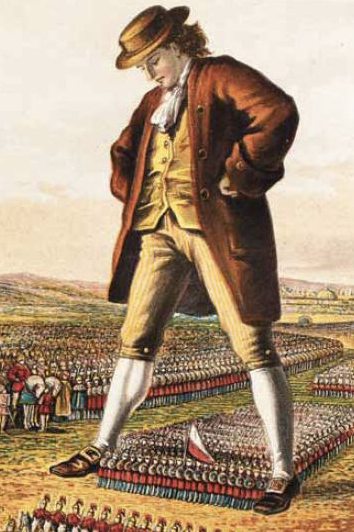
Critics have noted the extraordinary attention that Gulliver pays to clothes throughout his journeys. Every time he gets a rip in his shirt or is forced to adopt some native garment to replace one of his own, he recounts the clothing details with great precision. We are told how his pants are falling apart in Lilliput, so that as the army marches between his legs they get quite an eyeful. We are informed about the mouse skin he wears in Brobdingnag, and how the finest silks of the land are as thick as blankets on him. In one sense, these descriptions are obviously an easy narrative device with which Swift can chart his protagonist’s progression from one culture to another: the more ragged his clothes become and the stranger his new wardrobe, the farther he is from the comforts and conventions of England. His journey to new lands is also thus a journey into new clothes. When he is picked up by Don Pedro after his fourth voyage and offered a new suit of clothes, Gulliver vehemently refuses, preferring his wild animal skins. We sense that Gulliver may well never fully reintegrate into European society.
But the motif of clothing carries a deeper, more psychologically complex meaning as well. Gulliver’s intense interest in the state of his clothes may signal a deep-seated anxiety about his identity, or lack thereof. He does not seem to have much selfhood: one critic has called him an “abyss,” a void where an individualcharacter should be. If clothes make the man, then perhaps Gulliver’s obsession with the state of his wardrobe may suggest that he desperately needs to be fashioned as a personality. Significantly, the two moments when he describes being naked in the novel are two deeply troubling or humiliating experiences: the first when he is the boy toy of the Brobdingnagian maids who let him cavort nude on their mountainous breasts, and the second when he is assaulted by an eleven-year-old Yahoo girl as he bathes. Both incidents suggest more than mere prudery. Gulliver associates nudity with extreme vulnerability, even when there is no real danger present—a pre-teen girl is hardly a threat to a grown man, at least in physical terms. The state of nudity may remind Gulliver of how nonexistent he feels without the reassuring cover of clothing.
Now you can test what you have learned here.